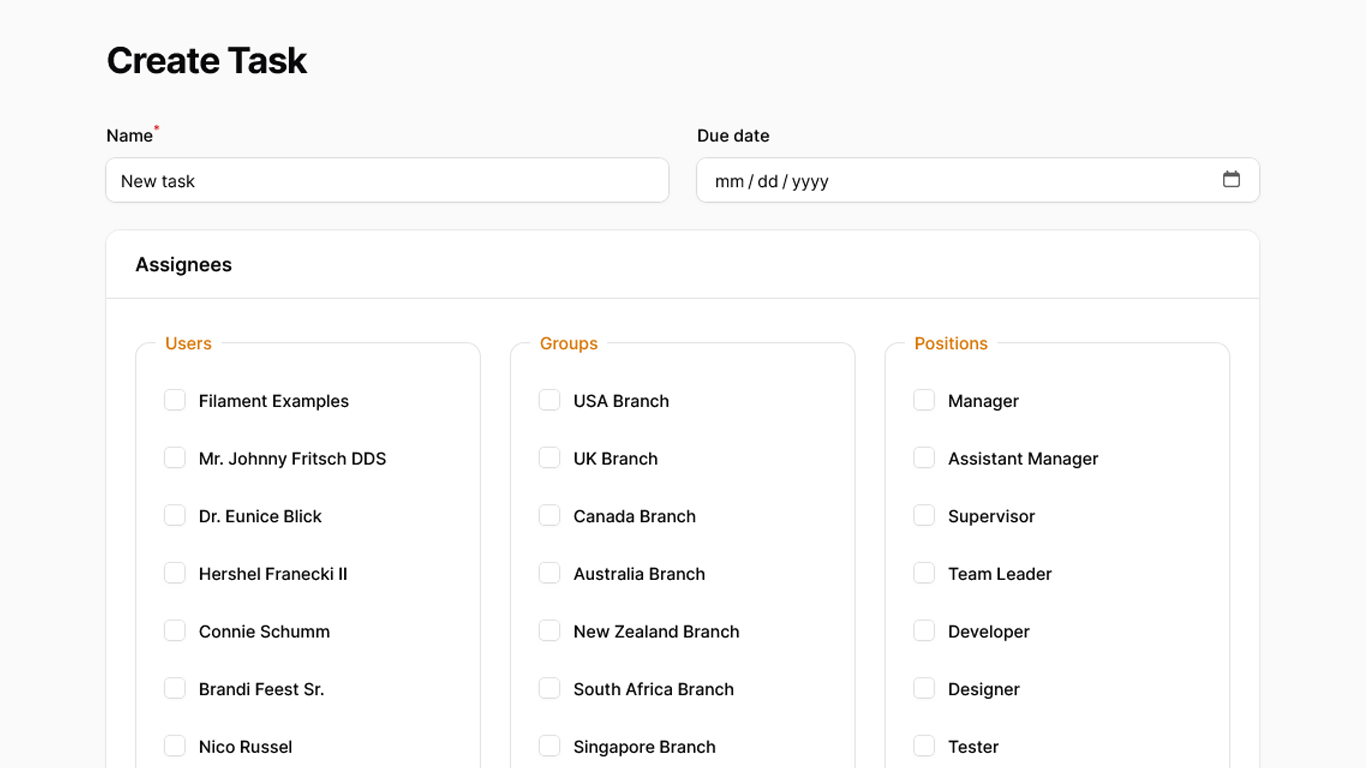
This project demonstrates how to organize form checkboxes into groups with restrictions to choose values only from one group.
Get the Source Code:
Only This Example
$9
One-time payment
Full source code for Complex Multi-Group Form
Downloadable ZIP file with the source code
Lifetime access to this example
 Sign in with GitHub to buy
Sign in first, then complete your $9 checkout.
Best value — all 177 examples
View membership plans
FilamentExamples Membership
$99
/year
or
$199
lifetime
Access to code of all 177 examples
Future new examples and updates included
FilaCheck Pro package licence included
MCP server included
30-day money-back guarantee
How it works
The main logic here lives between form() method on our Resource and the create and edit functions
- Three different groups of checkboxes - Users, Groups, Positions
- Each group has a set of checkboxes that can't be mixed. For example, if you selected Users, you can't select any other group
- Each of the checkbox is reactive and generated real-time for the form.
- There is a hydration logic for the checkboxes, so that when you edit the form, the checkboxes are pre-selected.
- We will override the input format on both create and edit actions using
CreateTaskandEditTaskfiles to fit our new format and save relationships manually
Here's how that looks in our form() method:
return $form ->schema([ Forms\Components\TextInput::make('name') ->required() ->maxLength(255), Forms\Components\DatePicker::make('due_date'), // New section with checkboxes Forms\Components\Section::make('Assignees') ->schema([ // We are creating a new fieldset for Users Forms\Components\Fieldset::make('Users') ->extraAttributes(['class' => 'text-primary-600']) // We are creating 1 column for the fieldset ->columns(1) // We are setting the column span to 1 ->columnSpan(1) ->schema( // Here we dynamically generate checkboxes for each user by querying the database // ...
The FULL tutorial is available after the purchase: in the Readme file of the official
repository you would get invited to.